Posts

The history of Titanic

Image
On April 10th, 1912, the liner "Titanic", the luxurious ship they called unsinkable left Southampton on the first voyage to New York. The passengers were the mixture of the world's rich people in their magnificent first class accomodation, and also immigrants packed into steerage. The ship was believed to be so safe that she carried only 20 lifeboats, enough for only half of 2,235 passengers and crew. On the evening of April 14th, there was no wind and the sea was calm. The band were playing as the rich enjoyed their evening meal. At 9.40 p.m nearby ships warned of icebergs. However, the messages were not delivered. The owner of the ship who was on the board encouraging the captain to go faster to beat the record for crossing the Atlantic. Finally, a look-out on the bridge sounded the alarm but it was too late. At 11.40 p.m the Titanic struck an iceberg. Passengers felt only a slight bump and carried on dancing and dining. After all, this ship was unsinkable. In fact, t...

The Trojan Horse

Image
The Greeks and the Trojans had been at war for ten years. The exhausted Greek army was camped outside the city of Troy, when the Greek king Odysseus suddently had a good idea. He knew that horses were sacred animals to the Troyans so he decided to build a huge, hollow wooden horse on wheels. A horse big enough for some of his soldiers to hide inside. The horse was duly built and some of the soldiers climbed inside. The others set fire to the camp and pretended they were going to sail back home to Greece, defeated. In fact they hid nearby. The Trojans, delighted that the Greeks had left, immediately came out of the city gates and found the horse. They were very curious indeed. As part of the plan, the Greeks had left behind one soldier hiding near the horse. The Trojans soon found him and asked him about the horse. He said it was an offering to the goddness Athena. The Trojan tried to pull the huge horse into the city. However, it was so big that they had to tear down part of th...

The theory of the unconscious mind

Image
"The mind is like an iceberg, it floats with one-seventh of its bulk above water" Sigmund Freud (1856-1939) was born in Austria. He developed the technique of psychoanalysis in his treatment of patients with mental disorders. His most famous book, "The Interpretation of Dreams" was published in 1900. Freud argued that we all have an unconscious mind as well as a conscious one. The unconscious in where our motivations originate and our fears are buried. Memories, especially from childhood, have a huge influence on the way we are now, but we are unaware of their significance. We deny or resist becoming conscious of these motives. Freud's proposals came when strict scientific methods were seen as the only way to discover truth. By introducing the notion of the unconscious, Freud undermined the belief that we are in control of our actions, thoughts and behavious all the time. He is commonly referred to as "the father of psychoanalysis" and his...

Ten facts about Meghan Markle's wedding dress

Image
The dress chosen by  Meghan Markle  during her wedding with Prince Harry is  surely the most discussed type of cloths of the year. T he stunning, timeless dress in which  the 36-year-old Markle finally stood on the steps of St George's Chapel in Windsor   was the Claire Waight Keller's handiwork, who is artistic director of Parisian fashion house Givenchy. 1. Meghan's veil was embroidered with the national flowers of each of the 53 commonwealth countries. 2. The crops of wheat were blended with the flowers which symbolised love and charity. 3. The veil was decorated with the poppy of California (it represented Meghan's place of birth), and with a wintersweet, a flower that grows in Harry and Meghan's garden at Kensington Palace. 4.Hundreds of hours were spent to sew the flowers on the veil. 5. The veil which was carried by the sons of Meghan's best friend Jessica Mulroney was almost 8 meter long. 6. Meghan Markle's bouquet included flowers p...

The father of modern science

Image
"All truths are easy to understand once they are discovered; the point is to discover them"  Galileo Galilei (1564-1642) was born in Pisa, Italy. He spent years observing the movements of the planets through a telescope. At the time it was generally thought that the earth was the centre of the universe. Galileo believed, as Copernicus had done seventy years before, that the earth rotated on its axis once daily and traveled round the sun once every year. At the time, this was a fantastic concept and considered as dangerous by the Church who had told: "The proposition that the sun is in the centre of the world is absurd, philosophically false and heretical; it is contrary to Holy Scriptures" In 1633 he was considered guilty of heresy and spent the final years of life imprisoned in his own home. Galileo is referred as 'the father of modern science'. He paved the way for the separation of science and religion.

How Meghan Markle and Prince Harry broke royal traditions

Image
During the wedding a lot of royal traditions were broken. Fortunately, these changes were acceptable by the Queen. Number one: Meghan Markle and Prince Harry changed a lot over the Saturday wedding which was held at St. George's Chapel. The biggest break to royal protocol: the couple held hands during the ceremony—which is traditionally forbidden. Number two: On May 19th, Meghan Markle and Prince Harry will wed at St. George's Chapel at Windsor Castle. Traditionally, most royal couples get married at the capital's Westminster Abbey (for example, Prince William and Kate Middleton did it in 2011). This choice of venue isn't a full break rule from royal protocol—they followed a number of royal couples who walked down at the Windsor Castle. For instatnce, Harry's cousin, Peter Phillips and his wife Autumn Kelly were married at St. George's Chapel in 2008. Harry's father, Prince Charles, and stepmother, Camilla Parker Bowles, had a special b...

The Royal Wedding 2018

Image
Prince Harry and Meghan Markle married on May 19th, 2018. The decision to have a wedding on a Saturday was against tradition because usually royal weddings take place during a week. On the morning, 19th, it was announced that the Queen has given a Dukedom on Prince Henry of Wales. His titles is now Duke of Sussex, Earl of Dumbarton and Baron Kilkeel. Prince Harry is His Royal Highness The Duke of Sussex, and Markle has become Her Royal Highness The Duchess of Sussex. The marriage of Prince Harry and Markle took place in St George's Chapel at Windsor Castle. They became the 16th royal couple to celebrate their marriage at Windsor Castle since 1863. The Queen has given a permission for the ceremony in the place which seats approximately 800 people. Everything was paid for by the royal family. On the morning of the wedding, Meghan Markle's mother, Doria Ragland, accompanied her to Windsor Castle. Markle's father, Thomas Markle, wasn't at the wedding...

Southampton - "the Gateway to the World"

Image
128 kilometres from London lies the world-famous international port of Southampton, a veritable maritime hub known in Victorian times as the Gateway to the Empire and now called the Gateway to the World. The earliest settlements in the Southampton were seen in the Stone Age. The Romans, having conquered Britain, established the coastal defence settlement and trading port of Clausentum. In the 400s the Anglo-Saxons founded a new settlement near Clausentum, named Hampton from which deserves the name "the Country of Hampshire". The reign of Queen Victoria was the period when Southampton really began to expand. As the railway to London became work in 1840 and in 1842 was opened the city's first business dock owned by the Southampton Docks Company. Today, Southampton has an estimated population of approximately 251,565 inhabitants. Reaching it by public transport is easy: it's just one hour and nineteen minutes from London by train. The fastest jouney by bus from London...

The power of Elvis Presley

Image
"If you like rock 'n'roll, if you feel it, you can't help but move to it. That's what happens to me. I can't help it" Elvis Presley (1935-1977) is known as "the King". When he arrived on the pop scene in 1956, he introduced a new rhythm to music, sex, language and fashion. Before his arrival, adolescent kids dressed like their parents. Then Elvis shook his hips and changed everything. This new sex symbol charmed one generation and the same time discouraged another. Boys wanted to be him, girls fell in love with him and, what is more, all their parents hated him. The teenager was born. He did more than anyone else to invent youth culture. However, he was considered a dangerous threat to society. John Lennon said "Nothing really affected me until I heard Elvis. If there hadn't been an Elvis, there wouldn't have been a Beatles"

A small interesting fact

Image
Most of the world's wooly mammoths (the ancestory of today's elephants) had died out about 10,500 years ago. Although they are usually perceived to live together with dinosaurs, these animals actually existed  at the same time as early humans, who were partially responsable for killing them. There were many kinds of mammoth other than 'wooly mammoth', and some species were ever larger. The last mammoths actually lived until about 2,000 BC on a remote island in the middle of The Arctic Sea. To give a sense of the timeframe, this was about 560 years after the Great Pyramid of Giza was built. Enjoy! :) And something more joyful :)

Who was Emmeline Pankhurst?

Image
"We are here, not because we are law-breakers. We are here in our efforts to become law-makers" Emmeline Pankhurst Emmeline Pankhurst was born in 1858. She is seen by British people as "the principal fighter for women's equality in the UK". Until the 20th century women were not given the vote because they were considered to be incapable of rational thought. In bref, their place was in the home. In her twenties Emmeline belonged to the suffragists, who wanted to achieve equal voting rights for women by peaceful means. Later she led the suffragettes, who had a more militant approach.  On 18 December 1879, she married  Richard Pankhurst , a barrister  known for supporting women's rights to vote. They had five children over the next ten years. He supported her activities outside the home, she founded and became involved with the  Women's Franchise League , which advocated suffrage for both married and unmarried women. Suffragette's  tactics for att...

Calvin Klein - a passion for fashion

Image
Calvin Klein is a famous fashion designer. He has had a very interesting life so far. Let's analyse quickly the chart of events in his life :) At the age of: 0 - born on November 19, 1942, in the Bronx, New York 14 - developed a passion for fashion and drawing 18 - graduated from the High School of Art and Design 20 - studied at Manhattan's Fashion Institute of Technology where he met first wife, Jayne Centre 22 - married Jayne in September 1964 26 - launched his own clothing company with friend from the childhood, Barry Schwartz. Daughter, Marci, born 28 - started designing sportswear 30 - introduced his trademark Calvin Klein Jeans 31 - won the Coty Award (the youngest designer ever who won it). He won it three times, in 1973, 1974 and 1975 32 - divorced Jayne 40 - started selling his own Calvin Klein brand underwear 40-44 - won Fashion Designers of America award three times 44 - married one more time - Kelly Rector, a New York socialite 45 - started makin...

How football and rugby began :)

Image
As far back as 2500 BC the Chinese played  kicking game called "tsu chu". Similar games were played by the Romans and North American Indians. In England in medieval times "mob football" was very popular. In 1583, Phillip Stubbs said about players: "Sometimes their necks are broken, sometimes their backs, sometimes their legs, sometimes their arms" By the 19th century, with the help of English public schools, the game had become less violent. Each school had different rules for playing the game. On the playing fields of Eton the ball was kicked high and long. At Rugby School the boys caught and ran with ball. Problems arose when boys from the different schools went to the Universities of Oxford or Cambridge and wanted to continue playing. This is from the description of a match played in Cambridge in 1848: "The result was chaos, as every man played the rules he was accustomed to at his school" It became common to play half a match ...

Charles Darwin believed that ... ?

Image
"The mystery of the beginning of all things is insoluable by us; and I for one must be content to remain an agnostic" Charles Darwin His book, "On the Origin of Species by Means of Natural Selection", published in 1859 has been called "the book that shook the world". Today most scientists and ordinary people, with the exception of creationists, accept the theories included in this book. Darwin believed that all species (plants, animals and human beings) weren't created individually but have evolved over millions of years through a process of natural selection. In his opinion the species that could adapt best than others were those that survived. These ideas contradicted religious beliefs. People thought that God created Adam and Eve and all the animals. It was also believed that the Earth was just 4,000 years old. Others said: "Mankind is not descended from monkeys. There is no point in a world without God"

Winchester - the ancient capital of England

Image
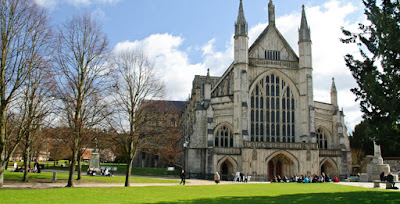
In the south of England, 99 kilometers from London, is the city of Winchester. With all rich history, beautiful and elegant old buildings this place is definitely worth seeing. Let's find out why it is one of Britain's most popular international tourist destinations. The most famous building in Winchester is undoubtedly the cathedral. It is the longest medieval cathedral in Europe. Building work began in 1079 and continued until its completion in 1532. On entry, we can admire the Winchester Bible, a selection of wall paintings and sculptures dating from the 1100s, an exhibition of contemporary art and of course the Cript. All year round, the Cathedral organises a lot of different events, including open-air-theatre, classical concerts and activities for children. You can stop at the coffee or dinner at the Cathedral Cafe and buy some souvenirs from the Cathedral Shop. Another important place in the city of Winchester is its castle and The Great Hall, one of the oldest Gothic ...

Who created the first computer?

Image
Hi! Today I'd like to tell you something about Charles Babbage, a person who originated the concept of a digital programmable computer. Charles Babbage was born on 26 December 1791. He was a scientist and an engineer. He had the idea of the first programmable computer. He wanted to build a machine that could do calculations without making the mistakes that human "computers" made. He designed a machine called The Difference Engine, and the British Government provided funds. The machine was never completed because Babbage ran out of money. Charles Babbage lived and worked for over 40 years in Marylebone, where he died, at the age of 79, of renal inadequacy on 18 October 1871. He was buried in London's  Kensal Green Cemetery . In 1991, a team of engineers from the Science Museum in London built one of Babbage's machines, using his original designs, and it worked perfectly. If you want to know more about Charles Babbage and his Difference Engine, I reco...

A few facts about Vincent Van Gogh

Image
Vincent Van Gogh was born in Brabant in the Netherlands in 1853. As a young man he worked as an art dealer in London and Paris. He was dismissed from this job because he had argued with customers about art. In 1881 he tried to commit suicide. He was depressed because he felt in love with his cousin, but she had rejected him. In 1886 he went to Paris to study art and it was while he was studying that he met Degas, Monet, Renoir. After two years living in Paris, Van Gogh went to live in Arles in the south of France. His friend Gauguin who he had met in Paris came to join him. The two men settled down in Arles, but there was a lot of tension between them. Vincent used to drink more and more, they quarrelled a lot mainly about the nature of art. One night in December 1888, Van Gogh left the house carrying a razor blade. He had been drinking and he had had an argument with Gauguin. He cut off part of his ear. After this he moved voluntarily into an asylum for the insane at St-Remy-...

Phenomenon of JK Rowling

Image
We all know JK Rowling. Today I would like to show you a few facts about her life and how her career has been changing over the years. The early years Joanne Kathleen Rowling, author of the best-selling Harry Potter series of books, was born in 1965, near Bristol. Her birthday, July 31, is the same as her famous hero, Harry Potter. School days Joanne did well in school. She liked learning languages, after that she studied French at university. She graduated in 1986. Over the next few years she had a variety of jobs. However, her passion was writing. She had written her first story, Rabbit , about a rabbit with measles, aged six. Harry Potter is born She started writing the first Harry Potter book in 1990. The idea for Harry - a lonely, 11-old orphan who is actually a wizard - came to Rowling while she was travelling by train between Manchester and London. Although she left England to teach English in Portugal, she continued to write Harry's story. She returned to Br...